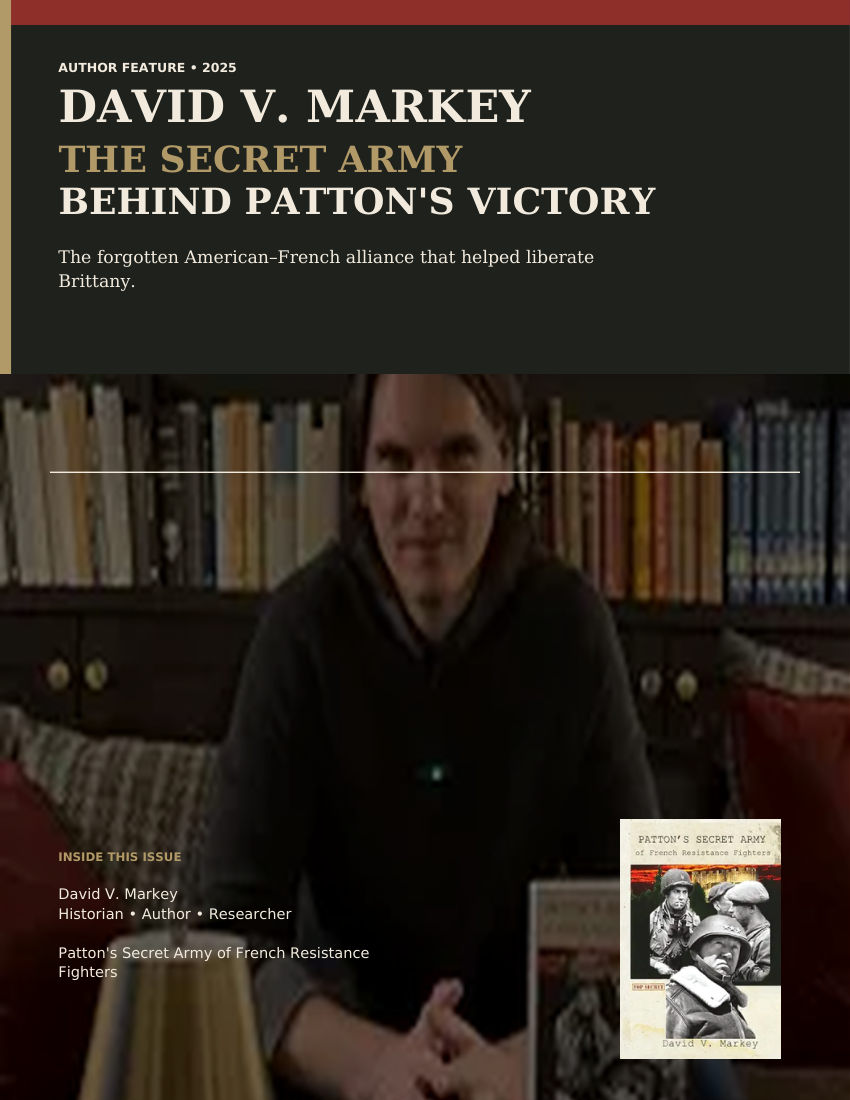
History is often remembered through its most famous names: generals, presidents, battles and victories. David V. Markey’s Patton’s Secret Army of French Resistance Fighters (Intaglio Press, 251 pages) turns to one of the overlooked stories — the cooperation between American forces and French Resistance fighters during the liberation of Brittany in 1944.
The historian
Markey earned a degree in History from the University of Michigan in 2019 and a master’s in Management from the Ross School of Business in 2020, before studying in Columbia University’s History and Literature program in Paris. His work turns on a single question: how do we know what happened in the past, and how do we tell that story responsibly?
When the armor arrived
The American soldiers of Patton’s Third Army entering Brittany were not entering an empty battlefield. The French Forces of the Interior — farmers, workers, fishermen, doctors, teachers and former soldiers — knew the roads, the countryside and the German positions. Jedburgh teams carried the radios that linked them to Allied headquarters.
“Special mention must be made of the great assistance given to us by the F.F.I. in reducing Brittany.”
Roughly 30,000 armed FFI fighters were associated with the campaign. They guided the 4th Armored Division through minefields, protected bridges, guarded roads and held positions until American troops arrived.
Reconstructing a secret war
Writing about an underground movement means working with false identities, destroyed records and fading memories. Markey draws on the Service historique de la Défense at the Château de Vincennes, the Archives nationales in Paris, U.S. Army battle reports and firsthand testimony.